




 AI Solutions



Table of Contents
An Alberta clinic manager is waiting on a new user login while patients are checking in. A BC marketing agency can’t open shared campaign files before a client review. An office admin is chasing a VoIP issue while customers keep calling. Time matters.
Sean Mansell, Information Technology Service Delivery Manager at Foresight for IT, notes: “Good IT support pricing starts with knowing which workflows cannot stop, who owns each system, and how quickly users need help when work is blocked.”
That’s why the cost of IT support for small business is really about staff time, accountability, and continuity. The right IT support cost for small business connects to faster tickets, clear service levels, remote and onsite help, and plain updates leaders can act on.
Cost Of IT Support For Small Business In Day-To-Day Operations
IT support affects approvals, customer response times, vendor fixes, and leadership follow-up. We use defined service levels, repeatable processes, and structured onboarding because the small details show up in daily work.
-
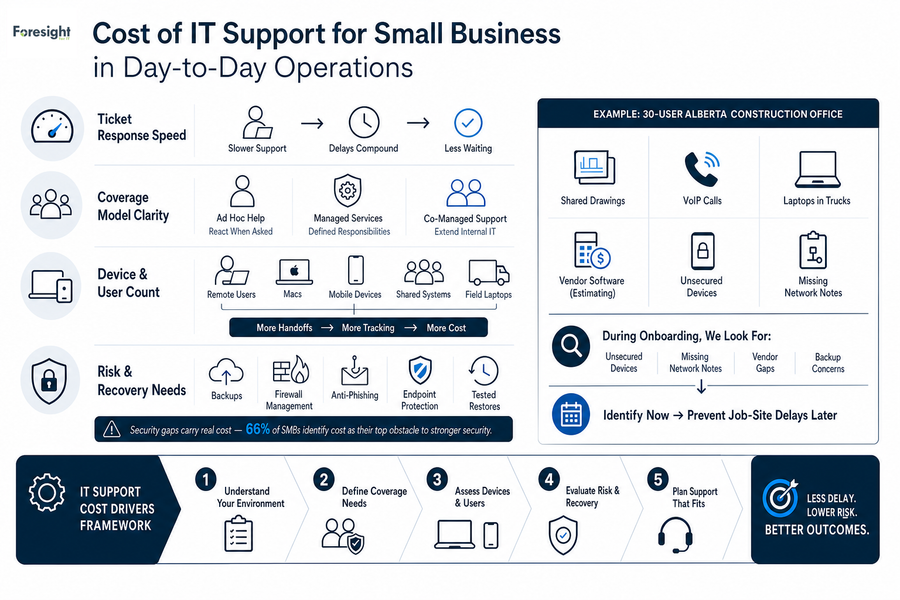
Ticket response speed: Slow support means a bookkeeper waits on file access, a manager delays approval, and customer work sits behind a ticket.
-
Coverage model clarity: Ad hoc help reacts when asked, managed services carry defined responsibilities, and co-managed support extends an internal IT person who’s already stretched.
-
Device and user count: Remote users, Macs, mobile devices, shared systems, and field laptops all add handoffs that need clear tracking.
-
Risk and recovery needs: Backups, firewall management, anti-phishing, endpoint protection, and tested restores shape the work because security gaps carry real cost, with 66% of SMBs identifying cost as their top obstacle to stronger security.
A 30-user Alberta construction office may rely on shared drawings, VoIP calls, laptops in trucks, and vendor software for estimating. During onboarding, we look for unsecured devices, missing network notes, vendor gaps, and backup concerns before they turn into job-site delays.
IT Support Cost For Small Business And What Changes The Scope
Two companies with the same user count can need very different support because approvals, apps, customer promises, and file handoffs don’t work the same way. IT support cost for small business has to be mapped to actual work.
-
How staff access systems: Remote work, shared devices, VPN access, cloud apps, and branch locations change how support is delivered.
-
How fast help must arrive: Service level agreements set expectations for urgent payroll, dispatch, or customer-facing issues.
-
How many vendors are involved: Internet, VoIP, copier, cloud, and line-of-business vendors all need coordination when responsibility bounces between providers.
-
How much security is required: Endpoint protection, anti-phishing, firewall oversight, backups, and training guidance matter when more than three-quarters of small businesses say a breach cost at least $250,000.
-
How mature documentation is: Missing passwords, unknown devices, unclear licensing, and undocumented networks slow every fix. We clean this up early, including backup records, device standards, and restore testing.
IT Support Cost Across Managed And Co-Managed Models
Support models should match operational responsibility. If your internal person handles daily requests but needs help with cybersecurity, projects, or vendor follow-up, the right model looks different from a fully outsourced office with no IT staff. The IT support cost should reflect who owns daily requests, security follow-through, planning, and vendor handoffs.
|
Support model |
Best fit |
Operational tradeoff |
|---|---|---|
|
Basic managed IT |
Smaller teams needing core support coverage |
Narrower scope, with fewer proactive layers |
|
Essentials managed IT |
Teams needing steadier service levels and oversight |
More structure, clearer review points, and more shared planning time |
|
Complete managed IT |
Organizations needing broader coverage across support, security, and planning |
More responsibilities moved to the provider |
|
Co-managed IT |
Internal IT teams needing extra capacity or skills |
Shared ownership must be clearly documented |
|
Full-time staff augmentation |
Sites needing consistent onsite help |
Dedicated support, with planning still required |
Coverage comes first, because unclear ownership slows tickets, vendor handoffs, approvals, and recovery work. Risk also belongs in the model discussion: CyberScoop reports that the average cyberattack cost for a small or midsize business is more than $250,000.
Key capability areas include helpdesk support, cybersecurity, cloud and server hosting, and vendor management.
Related IT Cost And Support Guides
Cost Of IT Support When Service Levels And Response Times Matter
Payroll is due, but the person approving hours is locked out. A receptionist can’t place VoIP calls. A marketing team is waiting on shared file access before a client deadline. The cost of IT support becomes easier to judge when service levels define how quickly help arrives and how resolution is tracked.
At Foresight for IT, service level agreements help remove guesswork. Our support metrics are practical: we resolve 93% of issues on the first call, respond in about 5 minutes on average, and close issues in about 3.5 hours on average, with 15 minutes on P1 and 1.25 hours on P2.
-
First call resolution: Fixing issues quickly reduces repeat tickets.
-
Priority handling: A downed phone system gets treated differently than a new software request because the customer impact is different.
-
Portal visibility: Users and leaders can manage requests in one place.
-
Reporting and reviews: Periodic reports show completed work, improvement areas, and proof of delivery reviewed with an Account Manager.
Clarify Your IT Support Costs
See how service levels, coverage, and daily workflows shape your IT support needs. Take the next step with Foresight for IT.
Average Cost Of IT Support Services And The Next Decision You Should Make
Searching for the average cost of IT support services is useful, but the better next step is defining what support must protect: staff time, customer service, data recovery, vendor coordination, and secure access. Downtime has a measurable business impact, with one report showing median annual downtime from high-impact outages at 77 hours. Staff readiness matters too; IBM reported that retaining and training staff reduced breach costs by USD 259,000 on average.
Changing support models takes coordination across leaders, staff, vendors, and existing systems. Start with clarity.
-
List core systems: Include remote staff, Macs, mobile devices, VoIP, cloud apps, and line-of-business software.
-
Find recurring delays: Look for tickets that interrupt customer calls, invoices, approvals, or deadlines.
-
Check recovery readiness: Confirm backups exist and restores are tested.
-
Review vendor ownership: Make sure internet, VoIP, software, and copier responsibilities are clear during outages.
-
Match the model: Decide whether managed IT, co-managed IT, or staff augmentation fits internal capacity.
We help small businesses across Alberta and British Columbia review managed IT, cybersecurity, cloud consulting, VoIP support, Mac support, procurement, vendor coordination, and practical IT planning. Contact Foresight for IT when you’re ready to clarify the right support model and make performance easier to review through defined SLAs, a support portal, and proof-of-delivery reporting.