




 AI Solutions



Table of Contents
Staff wait for laptop approvals, finance sorts renewal notices, and field crews need connectivity before the next service call. IT procurement best practices turn those moments into a controlled process for selecting, buying, implementing, and managing IT equipment and services.
A practical IT procurement best practice connects every purchase to a clear workflow, support expectation, and security requirement. IBM notes that top-performing companies using integrated operating models have reduced ordering costs by up to 52%, which shows why structure matters.
Vince Phillips, President and CEO at Foresight for IT, notes: “Procurement works best when the request explains the business outcome, the users affected, and the support path before anyone compares products or signs terms.”
IT Procurement Best Practices Start With Business Needs
Strong procurement starts before quotes, demos, or vendor recommendations. When teams agree on the business problem early, they avoid rushed buying that creates extra tickets, unclear ownership, and tools that don’t fit daily work.
Document the required outcome, affected users, and support needs. Then record security needs and operational limits before comparing products.
Key examples of this include:
-
Secure document access: A law firm may need staff to open client files from court, home, and the office without copying documents into personal storage.
-
Reliable field connectivity: An oil and gas crew may need tablets that sync work orders from remote sites, even when connectivity is limited.
-
Clear accountability: A nonprofit may need one system owner for user changes, device requests, and access approvals.
-
Support-ready implementation: A new tool should include ticket paths, training notes, and ownership so staff know where to go when something breaks.
Best Practices In IT Procurement Require The Right People Early
Procurement isn’t only a finance task. Operations sees downtime risk and IT sees support load. Legal reviews contract lock-in while leadership checks business fit. Vendors explain service limits and end users know where training gaps will show up.
That is why best practices in IT procurement depend on early, plain-English input from every group.
Specific Domain Scenario: An equipment supplier replacing technician tablets needs input from dispatch, warehouse staff, IT, and service managers. Dispatch cares about job status updates, technicians need rugged devices that work in the field, and IT needs a clear repair and replacement process. If those needs aren’t discussed together, the rollout can create more tickets than it solves.
Once the right people agree on needs, vendor comparison becomes much cleaner.
IT Procurement Process Best Practices For Comparing Vendors
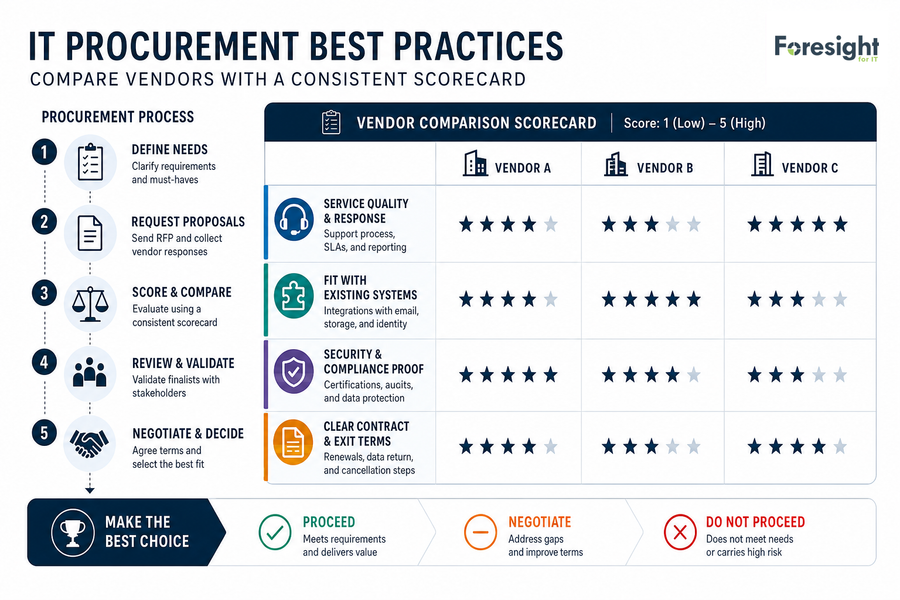
Vendor comparison needs a consistent scorecard before decision makers review proposals. With 88% of IT decision-makers open to switching at least some tech vendors, IT procurement process best practices should look beyond the first invoice and test how the vendor will perform after go-live.
Examples of this idea are:
-
Service quality and response path
Ask how support tickets are logged, prioritized, and reported. An SLA is a service level agreement that explains response times, resolution targets, and escalation steps in plain language. -
Fit with existing systems
Confirm the tool connects to email, file storage, user accounts, and daily workflows. Duplicate entry often becomes a support issue. -
Security and compliance proof
Since 41% of organizations require framework proof early, ask vendors for evidence before the shortlist. -
Reporting and vendor accountability
Review what proof of delivery the vendor provides after implementation, such as ticket reports, usage records, and performance updates. -
Clear contract and exit terms
Review renewal dates, data return, cancellation steps, and ownership of records.
Keep IT Vendors Accountable
IT Procurement Best Practice Checks For Security And Data Control
Cybersecurity belongs inside procurement before a contract is signed. Vendors may touch client files, student records, payroll data, or remote access. They may also support cloud apps, email, or network tools. Late review leaves teams asking who has access after the tool is already in use, while IBM reported the global average cost of a data breach reached USD 4.99 million in 2026.
Key examples of this include:
-
Access by role: Define who can view, edit, or export data. Tie delete rights and permission changes to job duties.
-
Remote access controls: Confirm how vendors connect to systems and how those connections are approved, monitored, and removed.
-
Incident reporting steps: Require clear timing, contacts, and communication steps for security events.
-
Backup and recovery: Confirm how data is protected, how often it can be restored, and who owns recovery.
-
Offboarding access removal: Document how vendor and staff access ends when contracts, roles, or projects change.
Make IT Procurement Easier
Turn purchases, renewals, and vendor decisions into a clearer process with Foresight for IT. Get help aligning procurement with daily operations.
IT Procurement And Best Practices For Contracts And Lifecycle Ownership
Procurement continues after the purchase order or agreement is signed. A new accounting platform, firewall, or laptop fleet needs implementation planning and asset tracking. It also needs license ownership, warranties, and renewal dates. Vendor reviews, secure disposal, and exit planning should be recorded before support confusion starts.
The next step is turning each purchase into an owned service with clear records for approvals, renewals, support, and accountability.
Core capability areas include implementation planning, asset records, vendor reviews, and secure disposal.
Best Practices For IT Procurement In Daily Operations
Change is hard when teams are already handling urgent requests, broken devices, and deadline-driven approvals. Small process habits make procurement easier to repeat, and IBM reports that designed simplicity principles make procurement functions 21% less likely to face added complexity.
Examples of this idea are:
-
Create one intake form: Capture the requester, system, user count, and deadline. Add the affected workflow and support need.
-
Assign one owner: Make one person responsible for approvals, vendor follow-up, and communication.
-
Standardize common devices: Keep laptop and tablet models consistent so setup and replacement are easier.
-
Track renewals and assets: Put licenses, warranties, contracts, and notice periods in one shared calendar. Record users and locations with serial numbers and support contacts.
-
Review after launch: Compare vendor promises against tickets, user feedback, response times, and unresolved issues.
Turn Procurement Into A Steadier Operating Habit
IT procurement works best when business needs, vendor accountability, and security review stay connected. Implementation and lifecycle ownership should follow the same plan instead of getting scattered across inboxes and last-minute approvals. Clear communication reduces confusion around approvals, renewals, support expectations, and system changes.
Contact Foresight for IT for practical, jargon-free guidance on building that structure. Foresight for IT can help with structured planning, clear ownership, service expectations, and dependable support.